
Egg Boiling Time Chart
The perfect boiled egg is mostly about timing. Choose how you like your yolk, your egg size and where your eggs are coming from, and this chart gives a starting time — then runs a countdown with an alarm. Stoves and pans vary, so note what works in your kitchen and adjust by 30 seconds next time.
- Free to use
- No sign-up
- Runs in your browser
Quick answer
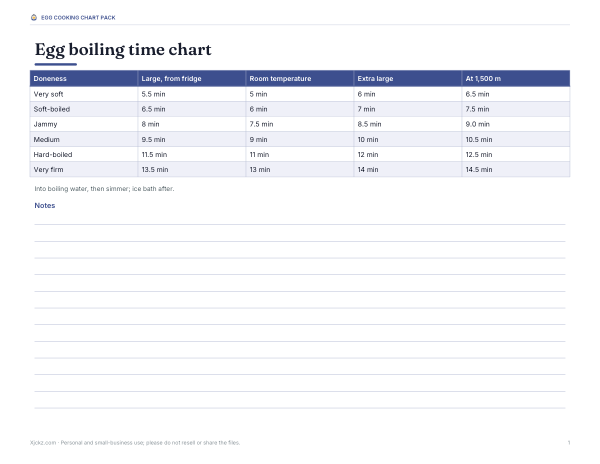
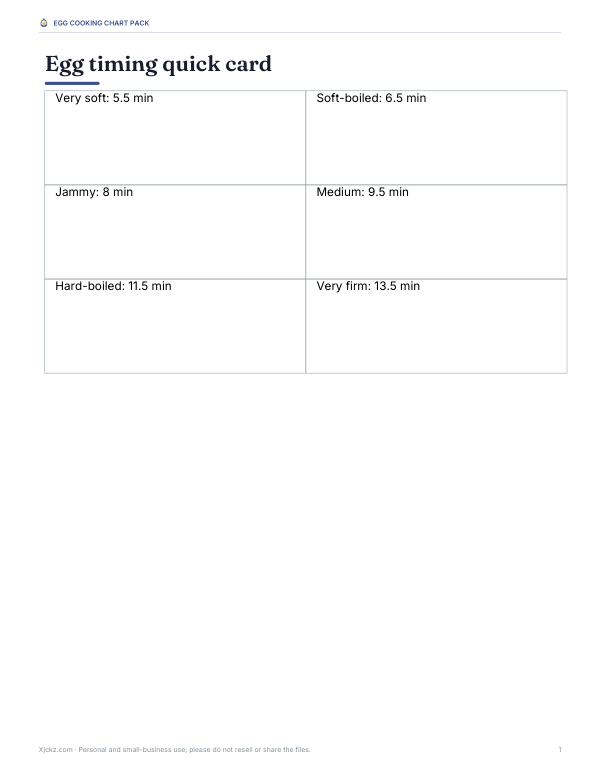
For large eggs straight from the fridge, use 6½ minutes for soft-boiled, 8 minutes for jammy, 9½ minutes for medium, and 11½–12 minutes for hard-boiled. Start them in boiling water, then cool in ice water. Subtract 30 seconds for room-temperature eggs; add about 1 minute at 5,000 ft (1,500 m).
Egg timer
Egg Cooking Chart Pack
Printable egg boiling time chart for the kitchen (with size, fridge and altitude adjustments), a fridge magnet-size quick card, a “my kitchen” timing log and a brunch egg planner.
- Kitchen chart (PDF)
- Quick card (PDF)
- Timing log (PDF/DOCX)
- Brunch planner (PDF/DOCX)
Formats: PDF, DOCX, XLSX. Instant download after payment (link valid 72 hours, up to 5 downloads). AI-assisted: the templates were drafted with AI help and reviewed and laid out before publishing.
$3.00 USD, one-time 4 files · about $0.75 each
- Instant download
- 7-day refund
- Secure checkout by Stripe
7-day money-back guarantee. Full refund within 7 days of purchase, even after you download.
Free sample: Brunch Egg Planner (PDF, 53 KB)
Full refund within 7 days — see the refund policy and license.
Free printables
Single sheets you can print right now, no sign-up. The full pack adds every sheet in one download plus the editable files.
 Printable Egg Brunch Planner
Egg Boiling Times and Adjustments
Use these times for large eggs from the fridge, lowered into boiling water, then adjust for size, starting temperature, and altitude.
| Result or adjustment | Time | Yolk | Note |
|---|---|---|---|
| Very soft | 5.5 min | Liquid | Runny edges |
| Soft-boiled | 6.5 min | Runny | Set white |
| Jammy | 8 min | Sticky-soft | For toast |
| Medium | 9.5 min | Mostly set | Soft center |
| Hard-boiled | 11.5 min | Fully set | Ice bath |
| Very firm | 13.5 min | Firm | For chopping |
| Room-temp eggs | -30 sec | Same | Any result |
| Medium eggs | -30 sec | Same | By size |
| Extra-large eggs | +30 sec | Same | By size |
| Jumbo eggs | +60 sec | Same | By size |
| 5,000 ft / 1,500 m | About +1 min | Same | Altitude |
| 10,000 ft / 3,000 m | About +2 min | Same | Altitude |
Egg boiling time chart (large eggs, from the fridge)
| Doneness | Time in boiling water | What you get |
|---|---|---|
| Very soft | 5.5 min | runny white edges, liquid yolk |
| Soft-boiled | 6.5 min | set white, runny yolk |
| Jammy | 8 min | soft, sticky yolk |
| Medium | 9.5 min | mostly set yolk, soft centre |
| Hard-boiled | 11.5 min | fully set yolk |
| Very firm | 13.5 min | for chopping or devilled eggs |
These times assume large eggs straight from the fridge, lowered into water already at a rolling boil and then simmered; they’re widely used starting points rather than exact rules. Room-temperature eggs cook about 30 seconds faster.
Adjusting for egg size
| Size | Adjustment |
|---|---|
| Medium | -30 seconds |
| Large | base time |
| Extra large | +30 seconds |
| Jumbo | +60 seconds |
US size grades are based on weight per dozen; other countries use different size names, so compare by weight if you’re unsure.
Cooking at altitude
Water boils at a lower temperature as you go higher — roughly 1 °C lower for every 300 m — so eggs take longer. At 1,500 m water boils at about 95 °C, and at 3,000 m at about 90 °C. The timer adds a little time for altitude; at high elevations, experiment with an extra minute or two and note what works.
Methods compared
| Method | How | Notes |
|---|---|---|
| Hot start (boiling water) | Lower eggs into boiling water, simmer, then ice bath | Most predictable timing; often easier to peel |
| Cold start | Eggs in cold water, bring to a boil, then off the heat for 10–12 min (hard) | Traditional; timing depends on the stove |
| Steaming | Eggs in a steamer basket over boiling water, lid on | Similar times to boiling; easy to peel |
| Pressure cooker | Follow the appliance’s egg programme | Times vary by model |
Worked example
For jammy eggs on toast, a cook chooses “Jammy”, large eggs straight from the fridge, at sea level: the timer sets 8 minutes (7½ minutes plus 30 seconds for cold eggs). At a mountain cabin at 2,000 m, the same settings add about 1 minute 20 seconds for the lower boiling point, and the cook notes in the margin of the printed chart that 9½ minutes worked best on that stove.
Easy peeling tips
- Use eggs that are a few days old; very fresh eggs are harder to peel.
- Start eggs in boiling water rather than cold water.
- Cool them straight away in iced water.
- Crack all over and peel under running water, starting at the wide end where the air pocket is.
- Store peeled hard-boiled eggs in the fridge and eat within a few days.
Other ways to cook eggs
| Style | Typical time | Tip |
|---|---|---|
| Poached | 3–4 min in barely simmering water | Use very fresh eggs and a splash of vinegar if you like |
| Coddled | 4–6 min in a coddler set in simmering water | Butter the coddler first |
| Baked (shirred) | 10–15 min at about 180 °C / 350 °F | Remove when whites are just set |
| Oven “hard-boiled” | About 25–30 min at 160–175 °C | Results vary; ice bath after |
| Sous vide | About 45–60 min at 63–64 °C for a custardy egg | Follow a tested guide |
Times are common starting points; adjust to your equipment and taste.
Storing and using boiled eggs
- Refrigerate hard-boiled eggs in the shell and use within about a week.
- Peeled eggs keep best covered in the fridge and eaten within a few days.
- Soft and jammy eggs are best eaten fresh; jammy eggs can be marinated for ramen for a day or two in the fridge.
- A grey-green ring around the yolk means overcooking — shorten the time or cool faster.
- Mark boiled eggs with a pencil “B” if you store them next to raw ones.
Food safety
Keep eggs refrigerated, cook soft and runny eggs only if you’re comfortable with the risk, and consider pasteurised eggs for pregnant people, young children, older adults and anyone with a weakened immune system, as many food-safety agencies advise. Refrigerate cooked eggs within two hours.
Frequently asked questions
What egg boiling time should I use at high altitude?
Start by adding about 1 minute at 5,000 ft (1,500 m) or about 2 minutes at 10,000 ft (3,000 m). Water boils cooler at altitude, so fine-tune by 30 seconds next time.
How do I adjust egg time for extra-large eggs?
Add about 30 seconds to the large-egg time. Jumbo eggs usually need about 60 seconds more.
Can one egg boiling chart work for fridge and room-temp eggs?
Yes. Use the fridge times as the base, or subtract about 30 seconds if the eggs are already at room temperature.
How long to boil an egg for a runny yolk?
About 6–6½ minutes for a large egg from the fridge, lowered into boiling water.
How long for hard-boiled eggs?
About 11–12 minutes for large eggs from the fridge.
How long for jammy eggs?
About 7½–8 minutes.
Do I start eggs in cold or boiling water?
Starting in boiling water gives more consistent timing and often easier peeling.
Why add time at altitude?
Water boils at a lower temperature higher up, so eggs cook more slowly.
Why ice water afterwards?
It stops the cooking and helps with peeling.
Why do some eggs crack when boiling?
Sudden temperature change; lower them in gently with a spoon and keep the water at a steady simmer.
Does salt or vinegar in the water help?
They can help seal small cracks; they don’t change the timing.
How many eggs can I boil at once?
As many as fit in one layer with water covering them by about an inch; more eggs cool the water, so allow extra time.
Can I use the timer for other cooking?
Yes — pick a doneness and adjust, or just use it as a kitchen countdown.
Why is my yolk off-centre?
Eggs stored on their sides or older eggs can have off-centre yolks; it doesn’t affect taste.
Are brown and white eggs cooked the same?
Yes — shell colour doesn’t change cooking time; size and temperature do.
What about quail or duck eggs?
Quail eggs cook in about 2½–4 minutes; duck eggs need a couple of minutes more than large hen eggs.